Spis treści
Introduction
Subject Scope of the Study
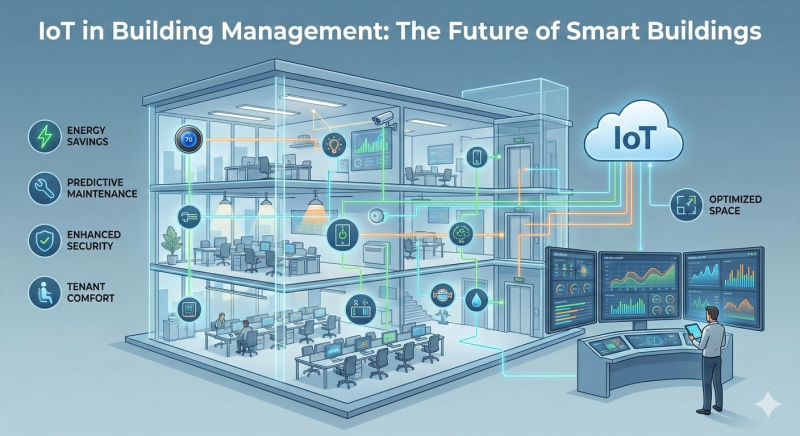
This study addresses the integration of Internet of Things (IoT) technologies in modern building engineering and facility management systems (Building Management System – BMS). The substantive scope of the work includes an analysis of the evolution of buildings from passive structures to highly interactive systems that, thanks to a dense network of sensors and actuators, are able to optimize their operational parameters in real time. Particular attention is paid to the synergy between the hardware layer (end devices) and the analytical layer (data processing algorithms), highlighting the crucial role of communication protocol interoperability in creating a coherent smart building ecosystem. The impact of these solutions on energy efficiency, asset security, and the psycho-physical comfort of end-users is also analyzed.
Explaining the Concept of the Internet of Things in Construction
Internet of Things (IoT) - is a term defined in 1999 by Kevin Ashton, originally in reference to RFID systems, but the modern definition (based on IEEE and ISO/IEC standards) is much broader. In the context of construction, it is defined as a network of physical objects—sensors, actuators, and devices—connected to a network that collect and exchange data to optimize the operation of a facility. These systems go beyond traditional building automation (BMS), offering deep integration and real-time analytics.
It is worth noting, however, that this definition is evolving. As Z. Kęsek points out, the modern understanding of a smart building goes beyond technology itself—it is a pursuit of architecture that, through intelligence, blends into the natural environment rather than just controlling devices. “The idea of a smart, intelligent space consists in the innovative implementation of information technologies in various aspects of human life. It is an integrated action of an intelligent human being for their own development and the realization of the idea of architecture that neutrally fits into the natural environment.” 1)
A key element of this definition is the transition from an “automated building” to an “intelligent building.” While classic automation relied on rigid algorithms (e.g., turn on the light when motion is detected), IoT introduces an analytical layer based on historical data and prediction. An intelligent building management system uses IoT to create a so-called “Digital Twin” of the facility, allowing for the simulation of various operational scenarios and the selection of the most effective one. As defined by the creator of the concept, Michael Grieves: “The Digital Twin is a set of virtual information constructs that fully describe a potential or actual physical product from the micro-atomic level up to the macro-geometric level.” 2)
These systems are characterized by three fundamental features:
- Ubiquity: Sensors are integrated directly into structural and installation elements.
- Context-awareness: Devices understand the context of the environment (e.g., they know that a higher temperature in a room results from sudden sunlight rather than an air conditioning failure).
- Scalability: The ability to add thousands of new measurement points without the need to rebuild the main network infrastructure.
System Comparison
| Feature | Traditional BMS | Modern IoT |
|---|---|---|
| Communication | Wired, closed | Wireless, open (MQTT) |
| Analytics | None / Basic | Advanced (AI/ML) |
| Implementation Costs | High | Scalable (starting low) |
Examples in the Field and Current State
Currently, IoT implementation in buildings extends far beyond simple temperature control. The most representative examples include:
- Smart Lighting Systems: Utilize external light intensity sensors and astronomical clocks to adapt the color and brightness of indoor lighting to the human circadian rhythm (so-called daylight harvesting), which directly impacts work productivity in office buildings and reduces energy consumption.
- Integrated HVAC Systems (Heating, Ventilation, Air Conditioning): These systems retrieve data from conference room booking calendars and occupancy counters to cool or heat a specific room only when it is actually needed, eliminating energy waste in empty zones.
- Intelligent Fire Safety Systems: Unlike traditional smoke detectors, IoT systems can indicate the exact path of fire spread and dynamically change the lighting of evacuation routes, directing people to a safe location.
- Structural Health Monitoring: The use of strain gauges and accelerometers in key structural nodes of high-rise buildings allows for the detection of micro-fatigue damage after strong winds or seismic shocks.
- Predictive Maintenance: Vibration and temperature sensors in elevators or pumps that predict a failure before it occurs.